

Windbreaks and Hedgerows in Vineyards
Katherine Favor, USDA National Agroforestry Center, May 2025
Windbreaks and hedgerows are two types of conservation buffers that can provide benefits
to vineyards and the surrounding landscape. Windbreaks are rows of trees and/or shrubs in
linear configurations, often established with the goal of slowing wind. Hedgerows are dense
groupings of trees, shrubs, and other plants in a linear design, planted to achieve a natural
resource conservation purpose such as providing habitat for wildlife, including pollinators
and beneficial natural enemies. Hedgerows and windbreaks are structurally similar and
perform many of the same functions. For example, many windbreaks can provide habitat
for beneficial fauna, and many hedgerows can slow wind. Both windbreaks and hedgerows
can be planted in and around vineyards to achieve production and conservation goals and
help vineyards adapt to and mitigate climate change.
Windbreaks and hedgerows can offer many benefits to vineyards and the surrounding
environment, including:
- Protecting plants from wind-related damage
- Improving grapevine photosynthesis
- Reducing soil erosion from wind
- Reducing evapotranspiration, resulting in improved water use efficiency
- Improving air quality by intercepting pesticide and herbicide drift, particulate matter,
odors, and dust - Reducing nonpoint source water pollution and groundwater pollution
- Providing habitat and food for wildlife
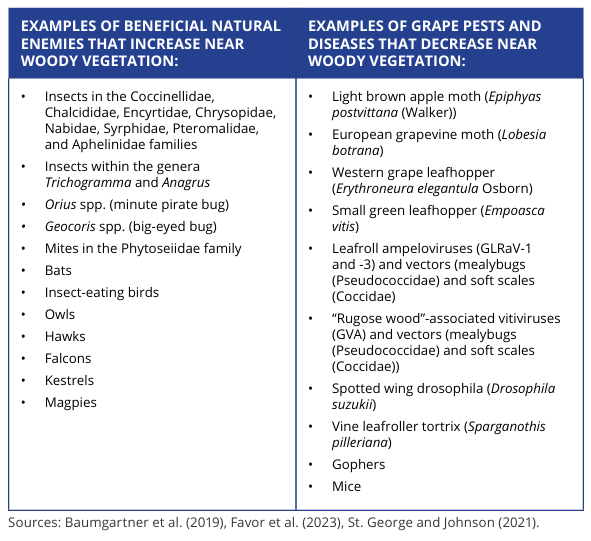
- Providing habitat and food for beneficial natural enemies for improved integrated pest
management - Increasing carbon sequestration
Includes detail on:
- Benefits for plant protection, soil health, water use and pest management
- Adapting to and mitigating against climate change
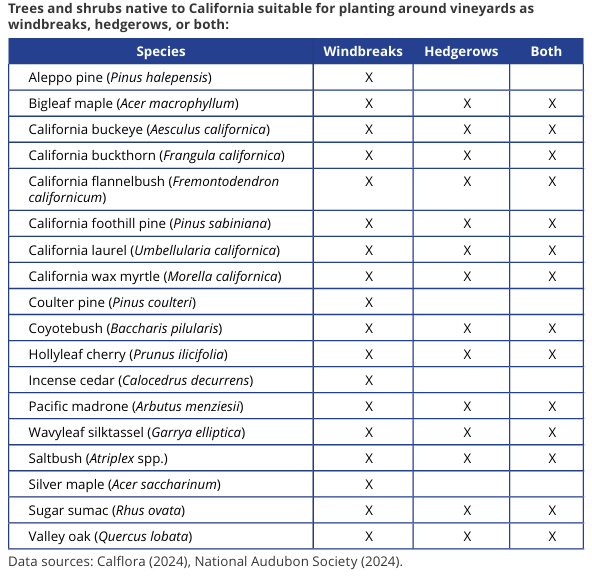
- Species selection
- Establishment
- Management
- Challenges and considerations